

What is Noise-Cancelling Technology?
Noise-cancelling technology is a revolutionary advancement in audio devices that allows users to block out unwanted external sounds, providing a more immersive and focused listening experience. It’s primarily used in headphones, earphones, and some speakers to improve sound quality and reduce distractions. Noise-cancelling devices are popular in environments like offices, airplanes, or busy public places, where external noise can hinder concentration or enjoyment of music, podcasts, and phone calls. In this post, you will learn about the Apple vs Samsung Noise-Cancelling Technology.
How Does Noise-Cancelling Technology Work?
Noise-cancelling technology works by using a combination of microphones, circuitry, and speakers to detect and cancel out unwanted ambient noise. There are two main types of noise cancellation:
Active Noise Cancellation (ANC):
ANC works by using small microphones on the headphones or earphones to pick up the surrounding sounds. The technology then generates an “anti-noise” signal, which is the exact opposite of the detected sound. This effectively cancels out the unwanted noise, allowing users to hear only the audio they want.Passive Noise Cancellation:
Unlike ANC, passive noise cancellation doesn’t use electronics but relies on the physical design of the headphones or earphones to block external sounds. For example, over-ear headphones have padded cups that form a seal around your ears, naturally reducing noise from the outside.
As we explore the advancements in noise-cancelling technology, we can also look at how AI agents are enhancing various technologies, including those used in noise-cancelling systems. Learn more about this in AI Agents Explained: What They Are, How They Work, and Why Everyone Is Talking About Them in 2025
What Technologies are Used in Noise-Cancelling Devices?
Microphones: Microphones detect the surrounding noise, which is then used to create an opposing sound wave.
Sound Waves: By generating a sound wave that is the inverse of the ambient noise, noise-cancelling technology can neutralize external sounds.
Audio Processing Chips: These chips process the input from the microphones, creating the anti-noise signal that is delivered to the speakers.
Speakers: The speakers then emit this anti-noise signal, which, when combined with the original noise, cancels out unwanted sounds.
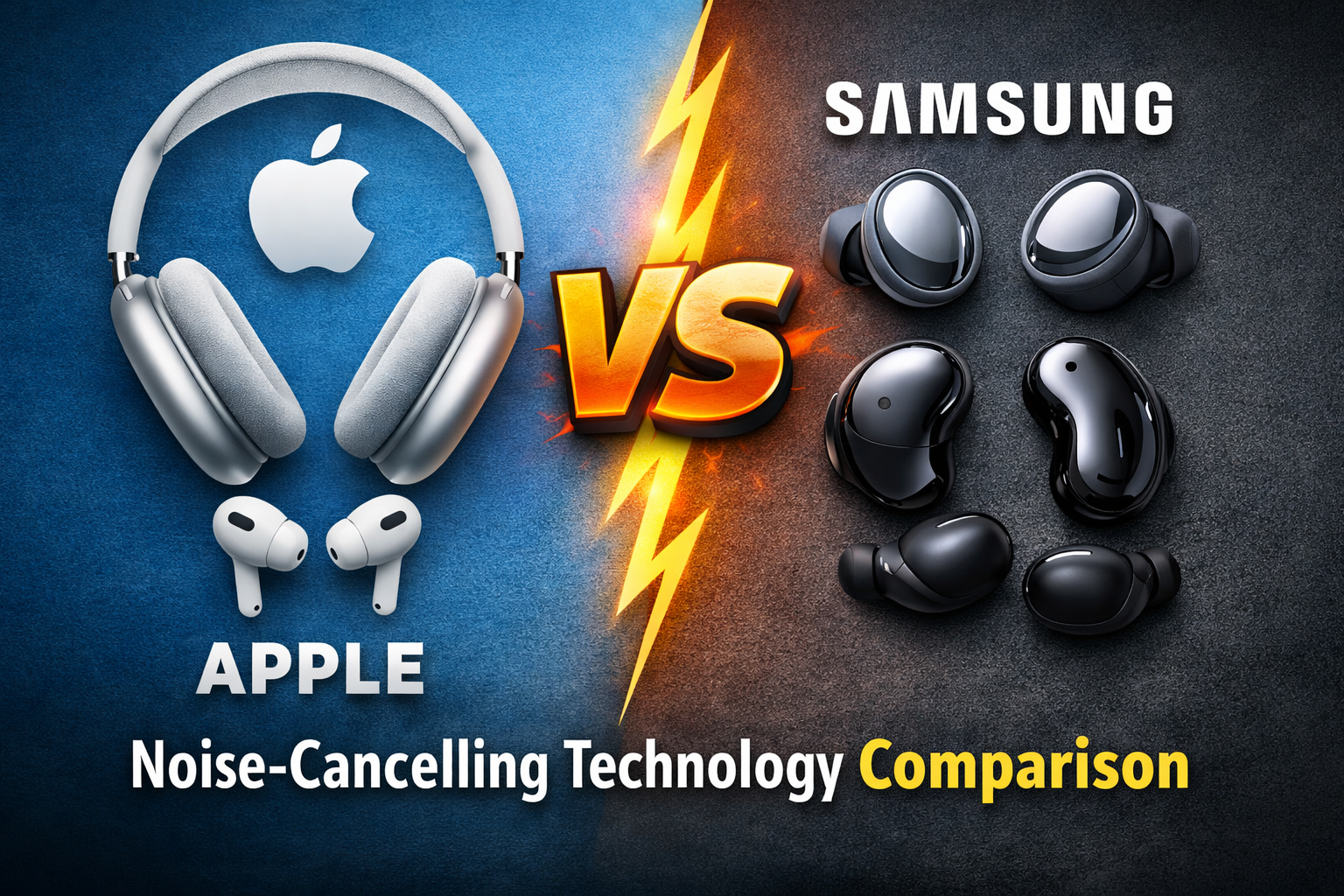
Apple vs Samsung Noise-Cancelling Technology: A Comprehensive Comparison (2025)
Noise-cancelling technology has become a standard in premium audio devices, especially for brands like Apple and Samsung. Both companies have developed cutting-edge noise-cancelling headphones and earbuds, offering consumers a choice between two of the leading brands in the market. But how do Apple and Samsung stack up when it comes to active noise cancellation, sound quality, battery life, and additional features? This article delves into the differences and similarities, helping you make an informed decision.
1. Active Noise Cancellation (ANC)
Apple:
Apple’s AirPods Pro and AirPods Max are equipped with cutting-edge active noise cancellation. AirPods Pro offer adaptive ANC, adjusting the level of cancellation based on the surrounding noise. The AirPods Max offer superior ANC performance due to their over-ear design, providing better noise isolation and cancellation. AirPods Max also feature the H1 chip for efficient processing.
Samsung:
Samsung’s Galaxy Buds Pro also offer strong ANC, particularly effective for blocking lower-frequency sounds like engine hums or the general noise in a bustling office. However, the Galaxy Buds Live provide a less powerful ANC experience due to their open-ear design. The Galaxy Buds Pro feature active noise cancellation and also offer an ambient mode for a more balanced sound experience.
Verdict:
Apple wins in terms of ANC performance, especially with the AirPods Max. However, Samsung’s Galaxy Buds Pro still offer good ANC for the price.
2. Sound Quality
Apple:
Apple’s AirPods Pro and AirPods Max provide excellent audio quality. The AirPods Pro offer rich bass, crisp highs, and a well-rounded midrange, especially with spatial audio for an immersive experience. The AirPods Max features large custom-built drivers and offers even more detailed sound with high-fidelity performance.
Samsung:
Samsung’s Galaxy Buds Pro are equipped with 12mm drivers that provide excellent bass and clear highs. 360 Audio in the Galaxy Buds Pro offers an immersive audio experience, similar to Apple’s spatial audio. However, Galaxy Buds Live do not have the same level of audio refinement and bass response as the Buds Pro and AirPods Max.
Verdict:
Apple offers superior sound quality, particularly with AirPods Max, while Samsung provides a good listening experience with Galaxy Buds Pro and their 360 Audio feature.
3. Battery Life
Apple:
AirPods Pro offer 4.5-5 hours of listening time with ANC on.
AirPods Max provide up to 20 hours of playback with ANC and spatial audio on.
Samsung:
Galaxy Buds Pro offer 5 hours of playback with ANC on, and 18 hours with the charging case.
Galaxy Buds Live offer 6 hours of battery life with ANC, and up to 21 hours with the case.
Verdict:
Samsung offers longer battery life with its Galaxy Buds Live and Galaxy Buds Pro, giving them an edge over Apple’s AirPods Pro.
4. Additional Features
Apple:
Adaptive Transparency mode allows users to hear environmental noise while keeping ANC active.
Spatial Audio with dynamic head tracking for a cinema-like experience.
Seamless integration with the Apple ecosystem (iPhone, Mac, Apple TV).
Samsung:
360 Audio offers a spatial audio experience similar to Apple’s Spatial Audio.
IPX7 water resistance for Galaxy Buds Pro, making them more suited for workouts and outdoor activities.
Bixby integration for hands-free controls.
Verdict:
Apple excels with Spatial Audio and Adaptive Transparency, especially for users within the Apple ecosystem. Samsung offers more practical features like 360 Audio and water resistance.
Comparison Chart: Apple vs Samsung Noise-Cancelling Technology
| Feature | Apple | Samsung |
|---|---|---|
| ANC Performance | Superior (AirPods Max) | Good (Galaxy Buds Pro) |
| Sound Quality | Excellent (AirPods Max, Pro) | Excellent (Galaxy Buds Pro) |
| Battery Life | AirPods Pro: 4.5-5 hrs, Max: 20 hrs | Galaxy Buds Pro: 5 hrs, Live: 6 hrs |
| Water Resistance | None | IPX7 (Galaxy Buds Pro) |
| Extra Features | Spatial Audio, Adaptive Transparency | 360 Audio, Bixby Integration |
Pros and Cons
Apple AirPods Pro and AirPods Max
Pros:
Exceptional ANC, especially with AirPods Max.
Superior sound quality with spatial audio.
Seamless integration with Apple devices.
Cons:
Expensive, particularly AirPods Max.
AirPods Pro have relatively shorter battery life compared to competitors.
Samsung Galaxy Buds Pro and Galaxy Buds Live
Pros:
Great ANC at a lower price point.
360 Audio offers an immersive listening experience.
IPX7 rating on Galaxy Buds Pro makes them water-resistant.
Cons:
Galaxy Buds Live have less effective ANC.
Bixby integration might not be as useful for non-Samsung users.
The Future of Noise-Cancelling Technology
Both Apple and Samsung continue to improve their noise-cancelling technology. Expect innovations like adaptive ANC, improved sound quality, and more personalized noise cancellation based on environment and usage. The future of noise-cancelling technology is also moving towards lighter, more comfortable designs, improved battery efficiency, and smarter audio processing with the integration of AI and 5G technologies. Noise-cancelling technology can make a huge difference in enhancing the gaming experience, providing clarity and focus in busy or noisy environments. Explore how this technology impacts cloud gaming in Cloud Gaming in 2025: The Complete Guide to Streaming Games Without Expensive Hardware
FAQs
Q1: Does noise-cancelling technology work on all types of noise?
A1: ANC is most effective at blocking low-frequency noises, such as engine noise or air conditioning. It is less effective at blocking high-frequency noises like speech.
Q2: Can I use noise-cancelling headphones without listening to music?
A2: Yes, you can activate ANC even when not listening to music. It will still help block out ambient noise, providing a more peaceful environment.
Q3: Which brand offers better noise-cancelling headphones?
A3: Apple has a slight edge in ANC performance, especially with the AirPods Max. However, Samsung’s Galaxy Buds Pro are a more affordable option with solid ANC and sound quality.
Q4: How can I improve the ANC on my headphones?
A4: Ensure a proper fit in your ears or around them for maximum noise isolation. A better seal improves ANC performance.
Q5: Are noise-cancelling headphones safe for long-term use?
A5: Yes, they are safe for extended use. However, taking breaks is recommended to avoid listening fatigue.