



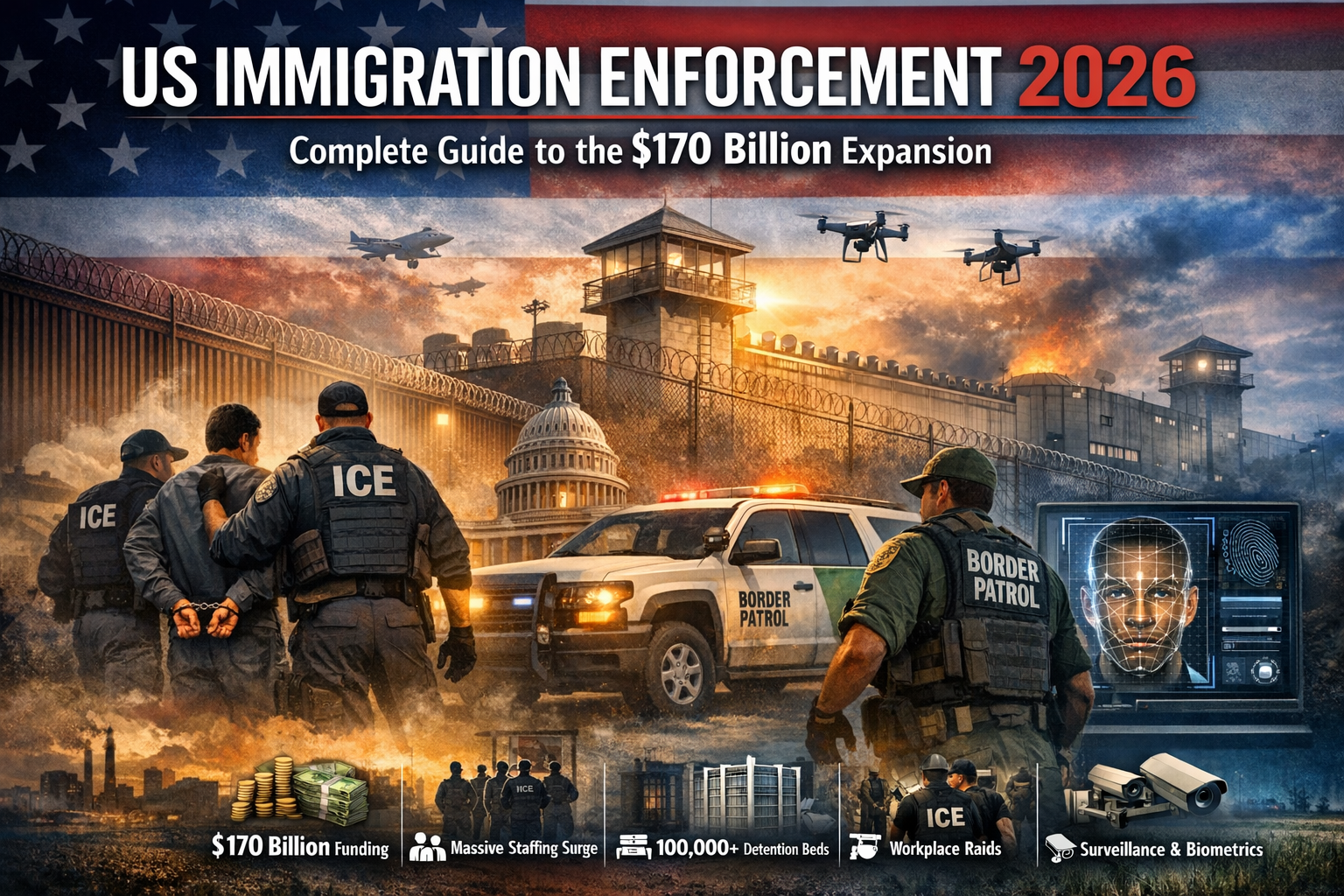
The United States is preparing for one of the largest immigration enforcement expansions in modern history. Beginning in 2026, the Trump administration’s comprehensive enforcement strategy will reshape how America handles immigration through unprecedented funding, staffing increases, and workplace operations.
This guide covers everything you need to know about the 2026 immigration enforcement changes, including funding details, workplace raid expectations, economic impacts, and what it means for businesses and communities.
Overview of 2026 Immigration Enforcement Changes
The 2026 immigration enforcement expansion represents the most significant shift in US immigration policy in decades. Congress has approved a comprehensive funding package that will transform how federal agencies approach immigration enforcement, moving beyond border-focused operations to extensive interior enforcement.
Key Changes at a Glance
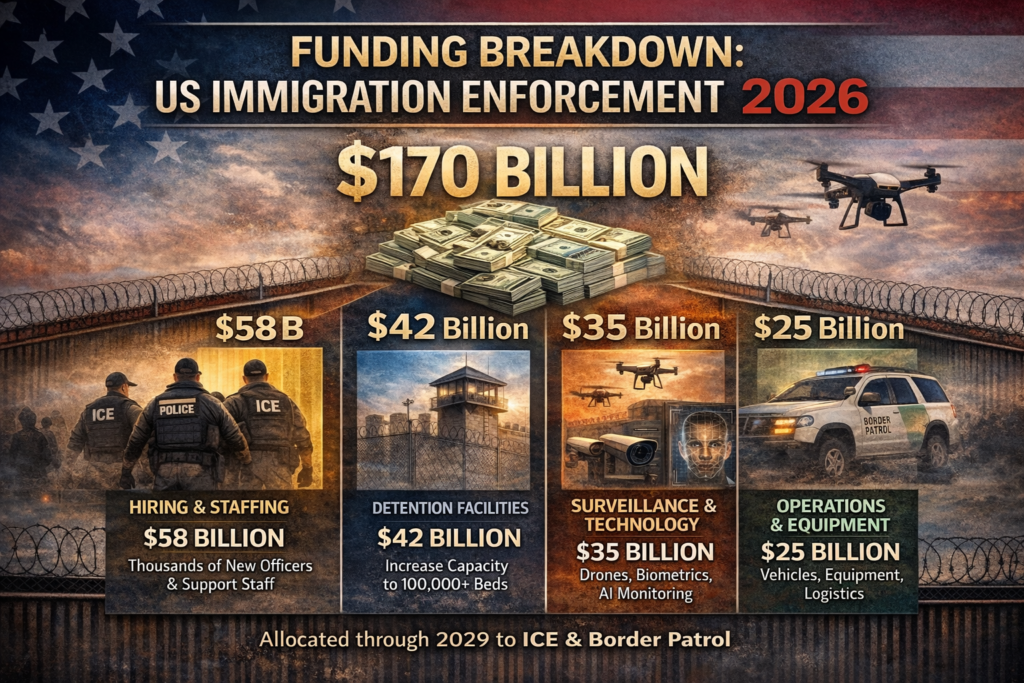
Funding Increase: $170 billion allocated through 2029 for ICE and Border Patrol operations, nearly tripling their previous annual budgets.
Staffing Expansion: Thousands of new immigration enforcement officers will be hired across multiple agencies.
Detention Capacity: Facilities capable of holding over 100,000 individuals simultaneously will be constructed or expanded.
Workplace Focus: Interior enforcement, particularly workplace raids, will become a primary enforcement strategy.
Technology Investment: Advanced tracking systems, biometric databases, and surveillance infrastructure will be deployed nationwide.
The scale of this enforcement expansion marks a fundamental shift from previous administrations, with implications reaching far beyond immigration policy into labor markets, civil liberties, and community stability.
Workplace Enforcement 2026: What Businesses Need to Know
The Shift to Interior Enforcement
Border Czar Tom Homan has confirmed that workplace enforcement will become a cornerstone of the 2026 immigration strategy. Unlike previous administrations that focused primarily on border interdiction, the upcoming approach emphasizes identifying and removing undocumented workers from job sites across America.
How Workplace Raids Will Work
Pre-Raid Intelligence Gathering ICE will increasingly use data analytics, I-9 audits, and confidential informant networks to identify businesses employing undocumented workers. Social Security Administration no-match letters will likely return as enforcement triggers.
Raid Execution Enforcement actions typically occur during early morning hours, with teams of 20-50 agents securing worksites, reviewing documentation, and detaining individuals suspected of immigration violations. Businesses face operational shutdowns lasting 4-12 hours during raids.
Post-Raid Consequences Employers may face civil fines ranging from $250 to $25,000 per undocumented worker, criminal prosecution for pattern violations, and mandatory re-verification of all employees. Businesses could also experience labor disruptions lasting weeks or months.
Enforcement Priorities
According to administration officials, workplace enforcement will prioritize:
- Critical Infrastructure Industries: Construction, manufacturing, energy production
- Agricultural Operations: Farms, processing facilities, packing houses
- Hospitality Sector: Hotels, restaurants, food service establishments
- Healthcare Facilities: Nursing homes, hospitals, home health agencies
- Logistics and Warehousing: Distribution centers, trucking companies
Warning Signs for Employers
Businesses should watch for these indicators of potential enforcement action:
- Receipt of I-9 audit notices or no-match letters
- Increased ICE surveillance near facilities
- Requests for employment records from federal agencies
- Reports of enforcement actions at similar businesses in the area
- Contact from ICE Homeland Security Investigations (HSI) division
Industries Most Affected by 2026 Immigration Enforcement
Construction Industry
Current Workforce Composition: Approximately 25-30% of construction workers are foreign-born, with significant undocumented representation in residential construction, roofing, drywall, and concrete work.
Expected Impact: Labor shortages could delay projects by 30-40%, increase construction costs by 15-25%, and create bottlenecks in housing development nationwide. Commercial construction timelines may extend significantly.
Geographic Concentration: Texas, California, Florida, Arizona, and Nevada face the highest exposure due to large immigrant construction workforces.
Agriculture and Food Processing
Current Workforce Composition: Agricultural workers are 73% foreign-born nationally, with particularly high concentrations in fruit and vegetable harvesting, dairy operations, and meat processing facilities.
Expected Impact: Harvest disruptions could lead to crop losses valued at billions of dollars. Food processing slowdowns may create supply chain bottlenecks affecting grocery prices. Dairy and poultry operations are especially vulnerable due to year-round labor needs.
Regional Vulnerability: California’s Central Valley, Florida’s agricultural regions, the Midwest’s meat processing corridor, and Pacific Northwest orchards face acute risk.
Hospitality and Food Service
Current Workforce Composition: Restaurants and hotels employ approximately 20-25% foreign-born workers, with higher concentrations in major metropolitan areas and tourist destinations.
Expected Impact: Service quality may decline, hours may be reduced, and menu prices could increase 10-18%. Many small restaurants and independent hotels may face closure due to inability to maintain adequate staffing.
Business Model Threat: Quick-service restaurants, full-service dining establishments, and budget to mid-tier hotels depend heavily on immigrant labor across both front-of-house and back-of-house positions.
Manufacturing
Current Workforce Composition: Manufacturing employs millions of foreign-born workers, particularly in food manufacturing, textiles, furniture, and automotive parts production.
Expected Impact: Production capacity could decrease 15-30% in affected facilities. Supply chain disruptions may cascade through multiple industries. Some facilities may relocate operations overseas rather than face enforcement uncertainty.
Supply Chain Risk: Auto parts manufacturers, food processors, furniture makers, and textile producers face significant operational risk.
Healthcare Services
Current Workforce Composition: Home health aides, nursing assistants, and facilities workers include substantial immigrant representation, particularly in elder care and long-term care facilities.
Expected Impact: Elderly care facilities may face critical staffing shortages. Home health services could become unavailable in many markets. Hospital support services may be disrupted.
Public Health Concern: The aging American population depends increasingly on immigrant healthcare workers, making this sector particularly sensitive to enforcement disruptions.
Public Opinion and Political Impact: 2025-2026 Trends
Shifting Polling Data
Public sentiment regarding immigration enforcement has shown notable changes throughout 2025, with implications for the 2026 midterm elections.
Overall Disapproval Rising By mid-2025, 51% of Americans disapproved of the Trump administration’s deportation program, up from 41% in February 2025. This represents a 10-point shift in just four months.
Critical Threat Perception Declining The percentage of Americans viewing immigration as a critical threat fell from 50% in 2024 to 36% in 2025, suggesting reduced urgency despite continued enforcement rhetoric.
Specific Policy Opposition
- 54% disapprove of increasing ICE workplace raids
- 59% disapprove of ending Temporary Protected Status programs
- 48% oppose expanded detention facilities in their communities
Partisan Divide Republican support for expanded enforcement remains strong at 78%, while Democratic opposition has solidified at 82%. Independent voters show 58% disapproval, a key swing demographic for 2026 elections.
Local Political Shifts
Several metropolitan areas have experienced political changes linked to immigration enforcement concerns:
Miami, Florida: Elected its first Democratic mayor in nearly three decades, with the mayor-elect citing immigration policy as a significant factor in voter sentiment shifts.
Suburban Counties: Multiple suburban counties in battleground states have seen local officials elected on platforms emphasizing civil rights protections and opposition to cooperation with ICE.
Sanctuary City Expansion: Additional municipalities have adopted sanctuary policies or limited cooperation with federal immigration enforcement, despite federal pressure.
2026 Midterm Election Implications
Political analysts identify immigration enforcement as potentially decisive in several Senate and House races:
Competitive Senate Seats: Arizona, Nevada, and Florida races feature immigration enforcement as top-tier issues, with candidates taking increasingly distinct positions.
House Districts: Suburban districts with significant immigrant populations show heightened engagement on immigration issues, particularly regarding workplace enforcement and community safety.
State Legislatures: Gubernatorial and state legislative races in Texas, California, New York, and Illinois feature prominent immigration policy debates affecting state-level cooperation with federal enforcement.
Voter Mobilization: Both pro-enforcement and immigrant rights organizations are investing heavily in voter registration and turnout operations focused on immigration-affected communities.
Economic Consequences of Expanded Immigration Enforcement
Labor Market Disruptions
Immediate Workforce Gaps Mass deportations and workplace raids create sudden labor shortages in industries with high immigrant workforce concentrations. Businesses report inability to find qualified replacement workers, particularly for physically demanding, seasonal, or lower-wage positions.
Wage Pressure Labor shortages typically drive wage increases of 15-30% in affected industries as employers compete for limited workers. While higher wages benefit workers, they increase business operating costs and can force price increases or business closures.
Skill Gaps Many immigrant workers possess specialized skills developed through years of industry experience. Construction trades, specialized agriculture techniques, and food processing expertise cannot be quickly replaced through new hiring.
Inflation and Consumer Prices
Food Price Increases Agricultural economists project food prices could rise 8-12% if enforcement significantly reduces farm labor availability. Produce, dairy, and meat products face the highest risk of price increases.
Housing Costs Construction labor shortages could increase new home prices by $15,000-$30,000 per unit, exacerbating America’s housing affordability crisis. Renovation and repair costs may increase 20-35%.
Service Price Inflation Restaurant meals, hotel rooms, and personal services may see price increases of 10-18% as businesses pass increased labor costs to consumers.
Overall Inflation Impact Federal Reserve economists estimate that comprehensive immigration enforcement could add 0.5-1.2 percentage points to annual inflation rates, complicating monetary policy and potentially delaying interest rate reductions.
Supply Chain Effects
Manufacturing Disruptions Production slowdowns in immigrant-dependent manufacturing sectors create bottlenecks affecting downstream industries. Automotive, food processing, and consumer goods supply chains face particular vulnerability.
Agricultural Losses Unharvested crops represent complete revenue losses for farmers, estimated at potentially billions of dollars annually. Perishable produce is especially vulnerable to labor shortage timing.
Logistics Challenges Warehousing and distribution operations depend heavily on immigrant labor. Disruptions could slow product delivery nationwide, affecting e-commerce and retail inventory management.
Business Closures and Economic Contraction
Small Business Vulnerability Independent restaurants, small construction contractors, and family farms operate with thin profit margins. Labor disruptions or enforcement penalties may force permanent closures.
Regional Economic Impact Communities with high immigrant workforce concentrations could experience localized economic contractions. Reduced consumer spending, business closures, and property value declines may create negative economic spirals.
Tax Revenue Losses Business closures and reduced economic activity decrease state and local tax revenues. Immigrant workers also pay substantial payroll and sales taxes that would be lost through deportation.
Long-Term Competitiveness Concerns
Investment Uncertainty Businesses may hesitate to invest in expansion or new facilities in regions with high enforcement risk, potentially directing capital to overseas operations instead.
Innovation Impact Immigrant entrepreneurs start businesses at higher rates than native-born Americans. Reduced immigration and increased enforcement may decrease business formation and innovation.
Global Competition Countries like Canada and Australia actively recruit skilled immigrants. Stricter US enforcement may redirect talent and entrepreneurship to competitor nations.
Legal and Civil Rights Considerations
Constitutional Challenges Expected
Multiple legal challenges to expanded enforcement are anticipated across several constitutional grounds:
Fourth Amendment Issues Workplace raids and expanded interior enforcement raise questions about unreasonable search and seizure. Courts will likely review warrant requirements, probable cause standards, and the scope of permissible enforcement actions.
Due Process Concerns Rapid deportation procedures and limited access to legal counsel create due process questions under the Fifth Amendment. Expedited removal processes face particular scrutiny.
Equal Protection Claims Enforcement targeting specific industries or communities may raise equal protection issues if implementation shows discriminatory patterns based on national origin or ethnicity.
First Amendment Implications Surveillance of immigrant advocacy organizations and potential retaliation against sanctuary jurisdictions create First Amendment questions regarding free speech and assembly.
Federal vs. State Authority
Sanctuary Jurisdiction Conflicts Federal efforts to compel state and local cooperation with immigration enforcement face Tenth Amendment challenges. Courts have previously ruled that the federal government cannot commandeer state resources.
State Licensing and Employment Law Conflicts between federal enforcement priorities and state employment protections, professional licensing, and labor standards will require judicial resolution.
Law Enforcement Cooperation The extent to which local police can be required or incentivized to participate in immigration enforcement remains legally contested.
Individual Rights and Protections
Workplace Rights All workers, regardless of immigration status, retain certain workplace protections under federal labor law. However, enforcement actions may have chilling effects on workers’ willingness to report violations or participate in union activities.
Family Separation Concerns Deportation of parents with US citizen children raises questions about family unity, children’s welfare, and the practical exercise of citizenship rights.
Access to Courts Detained individuals’ access to legal representation, ability to gather evidence, and opportunity to present defenses face practical limitations that may affect legal outcomes.
Expected Litigation Timeline
2026: Initial legal challenges filed in federal district courts across multiple jurisdictions, focusing on specific enforcement actions and program implementations.
2027-2028: Circuit court appeals consolidate issues, potentially creating circuit splits requiring Supreme Court resolution.
2028-2029: Supreme Court may take cases addressing fundamental questions about enforcement authority, due process requirements, and federal-state relationships.
Legal observers note that judicial review processes typically take 2-4 years, meaning enforcement practices may be fully operational before courts issue definitive rulings.
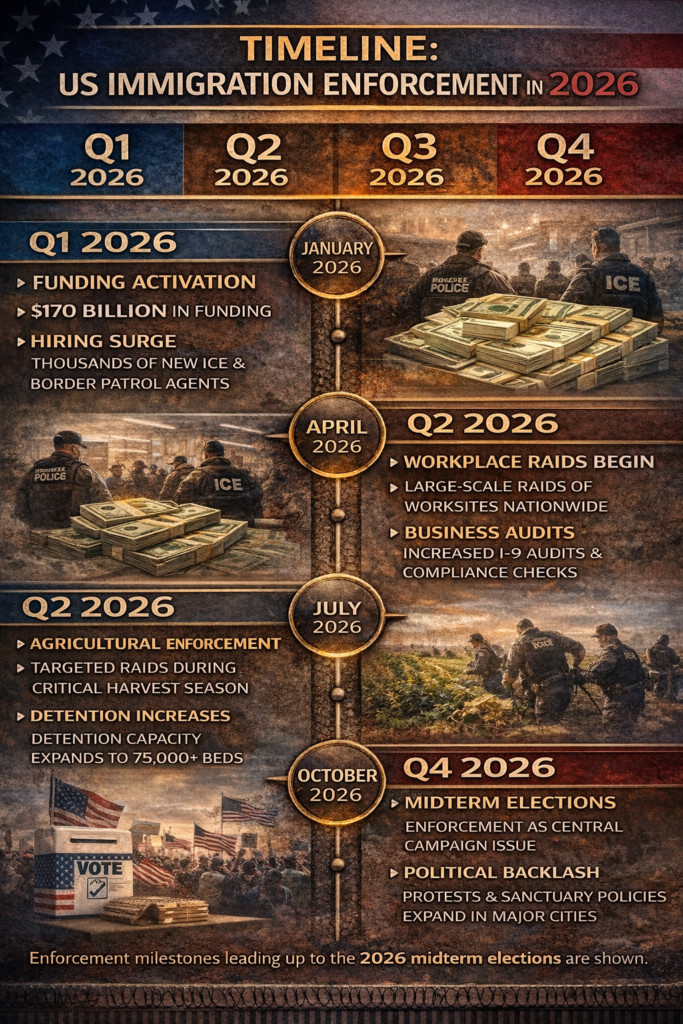
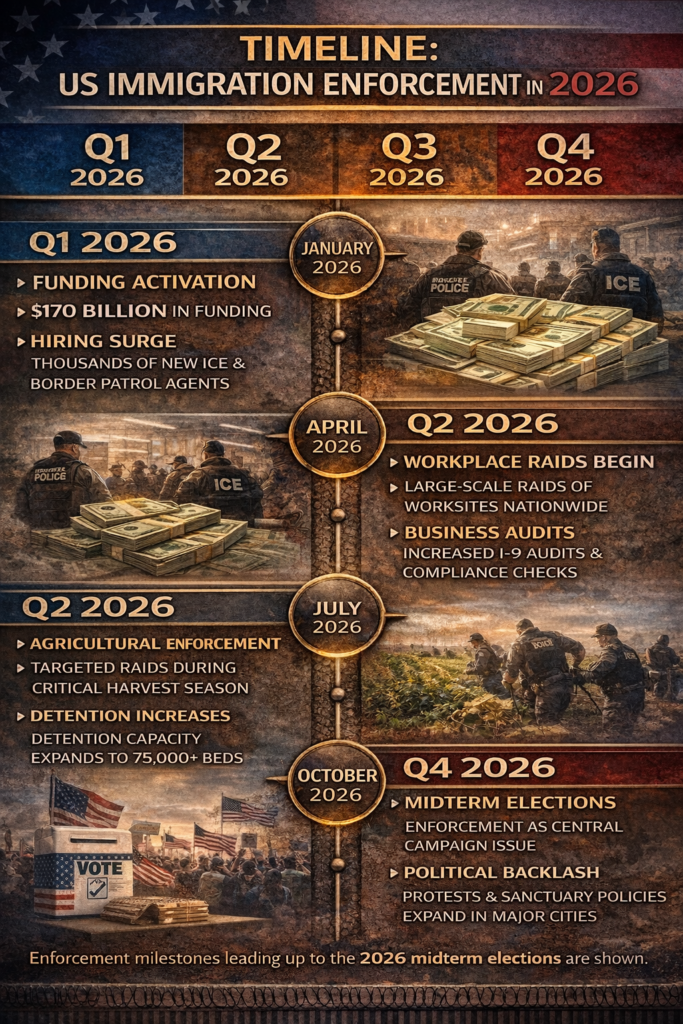
- Enforcement operations expand to additional geographic regions
- Agricultural sector enforcement increases during spring planting
- First quarterly reports on enforcement numbers and outcomes
- State and local resistance strategies solidify
May 2026
- Construction industry enforcement intensifies during peak season
- Congressional oversight hearings on enforcement implementation
- Community advocacy organizations mobilize response efforts
- Early labor market impact data published
June 2026
- Mid-year enforcement assessment and strategy adjustments
- Detention facility capacity reaches 75,000+ beds nationally
- Small business impact studies released by trade associations
- Political campaign season focuses increasingly on immigration
Q3 2026 (July – September)
July 2026
- Summer construction and hospitality enforcement peaks
- Federal court preliminary injunctions on some enforcement aspects expected
- Economic data shows measurable industry impact
- Voter registration drives in immigrant communities intensify
August 2026
- Agricultural harvest season enforcement operations
- Congressional Budget Office releases economic impact assessment
- Major industry groups lobby for enforcement modifications
- Campaign advertisements highlighting immigration dominate airwaves
September 2026
- Pre-election enforcement activity may slow or intensify depending on political calculations
- Final jobs reports before November elections show labor market effects
- Food price increases attributed to agricultural enforcement become visible
- Early voting begins in several states with immigration as top issue
Q4 2026 (October – December)
October 2026
- Final month before midterm elections sees peak political focus on immigration
- State and local races feature immigration enforcement as decisive issue
- Consumer price data shows enforcement-related inflation impacts
- Business groups increase pressure for policy adjustments
November 2026
- Midterm elections potentially serve as referendum on enforcement policies
- Voter turnout in immigrant communities may determine competitive races
- Post-election analysis shapes future enforcement strategies
- Congressional composition determines 2027 legislative possibilities
December 2026
- Annual enforcement statistics released showing first full year results
- Budget discussions for 2027 begin with enforcement funding considerations
- Legal challenges consolidate in circuit courts
- Administration assesses year-one implementation and plans adjustments
2027 and Beyond
The enforcement framework established in 2026 will likely continue through at least 2029 based on current funding commitments. However, political outcomes, legal decisions, and economic impacts will shape implementation intensity and specific strategies going forward.
What Businesses Should Do Now: Compliance Checklist
Immediate Actions (Next 30 Days)
1. Audit I-9 Forms Review all employee I-9 forms for completeness and compliance. Correct any errors or omissions through proper supplemental procedures. Incomplete or improperly completed forms create enforcement vulnerabilities.
2. Verify E-Verify Enrollment If operating in states requiring E-Verify or contracting with federal agencies, ensure proper enrollment and compliance. Document all E-Verify queries and maintain results securely.
3. Review Hiring Procedures Ensure hiring managers understand I-9 requirements, anti-discrimination provisions, and proper document verification procedures. Unintentional violations often result from inadequate training.
4. Establish Legal Counsel Relationships Identify immigration law attorneys who can respond quickly if ICE initiates contact or enforcement action. Pre-existing relationships enable faster response than searching during a crisis.
5. Document Retention Policies Verify that employment records, payroll documentation, and I-9 forms are properly maintained per federal requirements. Missing documentation complicates defense against enforcement actions.
Short-Term Preparations (Next 90 Days)
6. Workforce Contingency Planning Identify critical positions and develop succession plans accounting for potential sudden labor losses. Cross-training employees provides operational resilience.
7. ICE Interaction Protocols Develop written procedures for how managers should respond if ICE arrives at facilities. Employees should know whom to contact, what to say, and what legal rights businesses and individuals possess.
8. Know Your Rights Training Provide employees with information about their rights during enforcement actions. This protects both workers and businesses from improper enforcement procedures.
9. Industry Association Engagement Join relevant trade associations that monitor enforcement trends and provide compliance guidance. Collective action and shared intelligence help businesses navigate enforcement environment.
10. Financial Reserve Building Establish financial reserves to cover potential operational disruptions, legal costs, or civil fines. Businesses facing sudden labor losses need capital to survive transitions.
Long-Term Strategic Planning (6-12 Months)
11. Workforce Development Programs Invest in training programs to develop domestic labor pipelines. While challenging, businesses reducing dependence on potentially vulnerable workforces gain long-term stability.
12. Wage and Benefits Competitiveness Evaluate whether compensation packages can attract and retain workers in tighter labor markets. Higher wages may be necessary to maintain adequate staffing.
13. Technology and Automation Assess whether technology solutions can reduce labor intensity in some operations. Automation investments may provide long-term resilience but require significant capital and planning.
14. Geographic Diversification Consider whether operating locations should be adjusted based on enforcement risk, labor availability, and regulatory environment. Some businesses may benefit from facility relocation or expansion in lower-risk regions.
15. Government Relations Strategy Engage with policymakers at local, state, and federal levels regarding enforcement impacts on your industry. Businesses affected by enforcement should ensure their perspectives reach decision-makers.
Legal Compliance Essentials
Self-Audit Checklist
- All I-9 forms completed within 3 days of hire
- Section 2 completed within 3 business days of employment start
- Proper documents examined and recorded
- No prohibited practices (document demands, rejection of valid documents)
- Forms stored securely with appropriate access restrictions
- Retention schedule followed (3 years from hire or 1 year from termination, whichever is later)
- E-Verify (if applicable) completed within 3 days of hire
- No discrimination based on citizenship status or national origin
- Written workplace policies address immigration compliance
Red Flags Requiring Immediate Attention
- Receipt of Social Security Administration no-match letters
- ICE Notice of Inspection or I-9 audit request
- Subpoenas for employment records
- Employee reports of ICE surveillance near facilities
- Unusually high turnover among foreign-born workers
- Anonymous tips to immigration authorities
- Competitor businesses experiencing enforcement actions
- Media reports of enforcement in your industry or region
Frequently Asked Questions About 2026 Immigration Enforcement
General Questions
Q: When does the expanded immigration enforcement begin? A: The $170 billion funding package takes effect in January 2026, with initial enforcement operations expected to begin in Q1 2026 and scale throughout the year.
Q: Which states will see the most enforcement activity? A: Texas, California, Florida, Arizona, New York, Illinois, and Nevada are expected to experience the highest enforcement levels due to large immigrant populations and targeted industries.
Q: Can state and local governments prevent federal enforcement? A: No. Immigration enforcement is a federal authority. However, sanctuary jurisdictions can limit their cooperation with ICE, though they cannot actively obstruct federal officers.
Q: How many people could be deported under this expansion? A: Official projections are not public, but expanded detention capacity over 100,000 beds and statements from officials suggest hundreds of thousands of enforcement actions annually are planned.
Workplace Enforcement Questions
Q: How will ICE choose which businesses to raid? A: ICE uses data analytics, I-9 audits, tips and complaints, industry targeting strategies, and investigation of businesses with prior violations. High-profile enforcement sends deterrent messages to entire industries.
Q: What happens during a workplace raid? A: ICE secures the facility, reviews employee documentation, interviews workers, and detains individuals they believe are removable. Operations typically last several hours and can result in immediate arrests and prosecutions.
Q: Can employers refuse entry to ICE agents? A: Employers can refuse entry without a warrant signed by a judge. However, ICE often obtains warrants, and refusal may prompt more aggressive investigation. Legal counsel should guide these decisions.
Q: What are penalties for employing undocumented workers? A: Civil fines range from $573 to $23,331 per unauthorized worker. Criminal prosecution is possible for pattern violators, with potential imprisonment and permanent business prohibition.
Q: Will ICE announce raids in advance? A: No. Enforcement actions are not announced. Businesses may receive I-9 audit notices, but physical enforcement operations are unannounced to prevent evidence destruction or flight.
Economic Impact Questions
Q: Will food prices increase due to enforcement? A: Likely yes. Agricultural economists project food price increases of 8-12% if enforcement significantly disrupts farm labor. Produce, meat, and dairy face highest price risk.
Q: Could enforcement cause a recession? A: Large-scale enforcement could contribute to economic slowdown by disrupting labor markets and reducing consumer demand. However, a full recession depends on multiple factors beyond immigration enforcement alone.
Q: What industries will be hurt most? A: Construction, agriculture, food processing, hospitality, and healthcare services face the highest disruption risk due to significant immigrant workforce representation.
Q: Will enforcement affect my job security? A: Direct effects depend on industry. However, economic ripple effects from enforcement-driven inflation, supply chain disruptions, and reduced consumer spending could affect broader employment indirectly.
Legal Rights Questions
Q: What are my rights if ICE comes to my workplace? A: You have the right to remain silent, the right to speak with an attorney before answering questions, and protection against unreasonable searches. However, refusing to identify yourself to federal officers can have consequences.
Q: Can I be arrested for working without authorization? A: Unlawful presence is primarily a civil immigration violation, not a criminal offense. However, identity document fraud, false statements to federal officers, or illegal reentry after deportation are criminal offenses.
Q: Do I have to open my home to ICE agents? A: No. ICE must have a judicial warrant signed by a judge to enter private residences. Administrative ICE warrants do not authorize forced entry into homes.
Q: Can I video record ICE enforcement actions? A: Generally yes, from public areas. Recording in workplaces depends on employer policies and state laws. Never physically interfere with officers while recording.
Q: Should I answer questions from ICE? A: You have the right to remain silent and speak with an attorney first. Anything you say can be used in immigration proceedings. False statements to federal officers are crimes.
Family and Community Questions
Q: What happens to US citizen children if parents are deported? A: This creates extremely difficult situations. Citizen children can remain in the US with other guardians, or parents may take them to their country of origin. Family separation is a major humanitarian concern.
Q: Are there any protections for long-term residents? A: Legal permanent residents (green card holders) have significant protections. However, undocumented individuals, even with decades of US residence, have limited legal protections against removal.
Q: Will DACA recipients be targeted? A: This remains unclear and will likely be subject to litigation. DACA’s future under the current administration is uncertain despite previous court protections.
Q: Can churches and schools be raided? A: Federal policy traditionally designates houses of worship, schools, and hospitals as sensitive locations with limited enforcement. However, these policies can change and are not absolute legal protections.
Political and Policy Questions
Q: Could the 2026 elections change enforcement policies? A: Yes. If Democrats gain control of Congress in the 2026 midterms, they could use appropriations power to restrict or modify enforcement funding and priorities.
Q: Is there any path to immigration reform? A: Comprehensive immigration reform would require bipartisan congressional support, which appears unlikely in the current political environment. However, pressure from business interests and humanitarian concerns could eventually force negotiations.
Q: What do polls say about public support for enforcement? A: Polling shows divided public opinion. Overall disapproval of deportation programs has risen to 51%, but Republican support remains strong at 78%. Independent voters, who may decide 2026 elections, show 58% disapproval.
Q: Could courts stop the enforcement expansion? A: Courts can rule on specific enforcement practices, due process violations, and constitutional concerns. However, the fundamental authority of the federal government to enforce immigration law is well-established. Expect years of litigation without clear resolution.
Conclusion: Preparing for Immigration Enforcement Changes
The 2026 immigration enforcement expansion represents a watershed moment in US immigration policy. With $170 billion in funding, dramatic staffing increases, and a strategic shift to interior and workplace enforcement, the coming years will test America’s immigration system, economy, and social fabric.
Key Takeaways
For Businesses: Proactive compliance, contingency planning, and legal preparedness are essential. Industries dependent on immigrant labor should develop workforce strategies addressing potential disruptions while ensuring full legal compliance.
For Workers: Understanding legal rights, documenting employment authorization properly, and accessing legal resources can provide important protections during enforcement actions.
For Communities: Immigration enforcement will affect local economies, public services, and social cohesion. Community organizations, faith groups, and civic institutions will play crucial roles in supporting affected populations.
For Policy Observers: The 2026 midterm elections will likely serve as a national referendum on immigration enforcement. Political outcomes will shape the future intensity and direction of enforcement operations.
Looking Forward
Immigration policy sits at the intersection of economics, security, humanitarian concerns, and political ideology. The 2026 enforcement expansion will test whether America can balance security concerns with economic needs, civil liberties, and its historical identity as a nation of immigrants.
As implementation details emerge throughout 2026, businesses, communities, and policymakers must stay informed and engaged. The consequences of these enforcement policies will shape American society for years to come.
Additional Resources
Official Government Sources
US Department of Homeland Security Website: https://www.dhs.gov Provides official policy announcements, statistics, and enforcement guidance.
US Immigration and Customs Enforcement Website: https://www.ice.gov Offers enforcement priorities, statistics, and operational information.
Congressional Budget Office Website: https://www.cbo.gov Publishes economic impact analyses and budget information on immigration enforcement.
US Citizenship and Immigration Services Website: https://www.uscis.gov Provides information on legal immigration pathways, work authorization, and status adjustments.
Research and Data Organizations
Pew Research Center Website: https://www.pewresearch.org Offers comprehensive data on immigration trends, demographics, and public opinion polling.
Migration Policy Institute Provides independent immigration policy analysis and workforce data.
American Immigration Council Offers research on immigration economics, legal issues, and policy impact.
Legal Resources
American Immigration Lawyers Association Can help connect individuals and businesses with qualified immigration attorneys.
National Immigration Law Center Provides legal resources, know-your-rights information, and policy analysis.
Business Organizations
US Chamber of Commerce Advocates for business-friendly immigration policies and provides compliance resources to members.
National Association of Manufacturers Offers industry-specific guidance on workforce issues and immigration compliance.
American Farm Bureau Federation Represents agricultural interests regarding farm labor and immigration policy.