



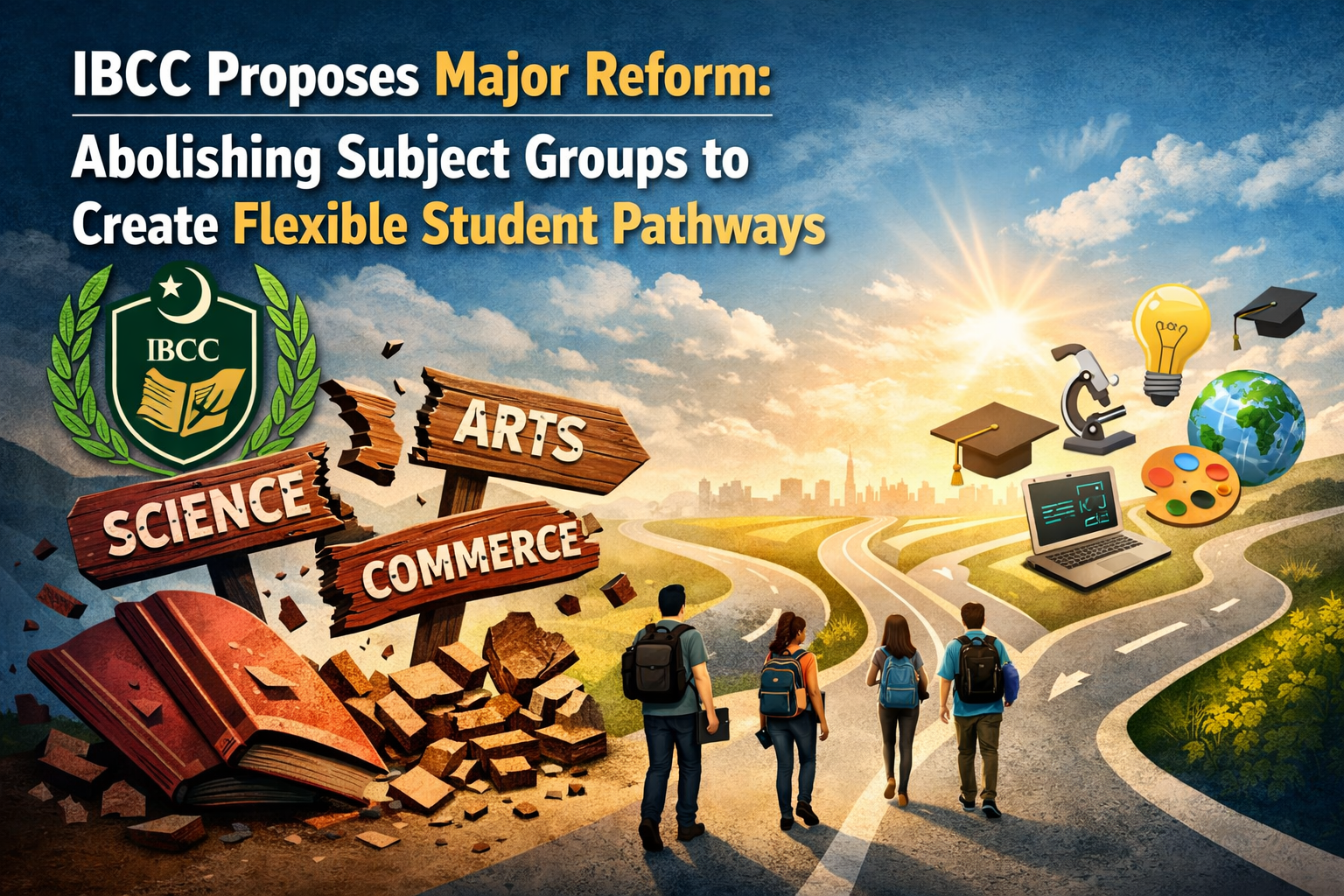
Inter Boards Coordination Commission Reform: IBCC Proposes Flexible Education Reform: has embarked on the intensive review of the inflexible system of subject group classification that is currently used in Pakistan to accommodate students before their entry is made into the higher education sector, and is proposing radical changes that have the potential to alter the current system of subject group classification radically.
Consultative Meeting Brings Key Stakeholders Together
The IBCC organized a high-level consultative meeting at its secretariat, where representatives of major educational bodies were invited to discuss the challenges remaining in the subject group classification at the Secondary School Certificate (SSC) and Higher Secondary School Certificate (HSSC) levels. The policies identified at the consultative forum are based on wider reform of IBCC that seeks to achieve widespread access to higher education more equitably. Recently, IBCC gave Pre-Medical and Engineering streams to Arts students beginning in 2026, and this move marks a clear departure of strong academic silos.
The conference, which was presided by the IBCC Executive Director Dr. Ghulam Ali Mallah, was aimed at addressing the challenges of students undertaking science courses but being offered humanities equivalence certification as an alternative, a category that considerably reduces their opportunities of higher education.
Current System Creates Barriers for Students
Dr. Ghulam Ali Mallah brought to light the fact that the current structure of subject groups places undue barriers to the movement of students and limits higher education. The existing system makes the students be subjected to predefined courses like; Engineering, Medical and General Science at the intermediate level irrespective of their actual courses combinations.
This very strict division especially makes it disadvantageous to the students who excel at most subjects in science but fail to meet the criteria set by the group, and this leaves the students in the humanities equivalency program, which is not quite a reflection of their performance.
Proposed Reforms: Moving Toward Subject-Based Admissions
At the meeting, stakeholders suggested that rigid subject divisions should be abolished and that instead their pathway should be based on flexibility and subjects. According to this restructured system, students would be judged to join a university according to certain subjects passed and not according to the predefined group classifications.
Higher Education Commission (HEC), Pakistan Medical and Dental Council (PM&DC), and National Curriculum Council, provincial curriculum boards and examination board representatives, all indicated that they support this idea by unbundling subjects and eliminating hard-core standards at the SSC level.
Formation of National Joint Working Group
To advance these reform proposals, participants established a national joint working group comprising representatives from all relevant educational institutions. This working group will conduct detailed examinations of the proposals and present comprehensive recommendations at the next consultative meeting.
Distinguished Participants
The meeting saw participation from senior education officials including:
- Mr. Fakir Muhammad Lakho, Chairman Sindh BCC
- Prof. Tasbih Ullah, Chairman KP BCC
- Dr. Ikram Ali Malik, Chairman FBISE
- Prof. Musharaf Ali Rajput, Chairman SBTE Karachi
- Prof. Jehanzeb, Chairman BISE Mardan
- Dr. Imdad Khushk, Controller Exams PMDC
- Dr. Tabassum Naz, Director NCC
- Mr. Qazi Abid, Director HEC
- Mr. Shafique Awan, Consultant
- IBCC officers
Representatives from BISE Quetta and curriculum authorities from Sindh, Punjab, and Balochistan attended virtually.
Key Recommendations from the Forum
Important Recommendations of the Forum under Inter Boards Coordination Commission Reform.
1. HSSC Level Reform: End pure subject-based groups in Higher Secondary School Certificate level and leave the universities and regulative authorities to decide on admissions on affected subject groups basis instead of group basis.
2. SSC Qualification Flexibility: Revise and streamline merit groups at Secondary School Certificate level, to be more open and flexible to college admissions.
3. Integrated Skill-Based Pathways: Explore integrating academic and vocational subjects or offering broader skill-based pathways at the SSC level to provide students with diverse educational options.
Alignment with International Best Practices
Interviewees were happy with the effort of IBCC in designing a platform of collaboration to solve student-driven problems. The reforms suggested are consistent with global best practices in education, where competency-based testing and multiple options are becoming popular in education as compared to inflexible systems of streaming.
Education systems in most advanced economies have abandoned the idea of early tracking and subject grouping as systems have been found to hold students back and make a false divide on the way to higher education.
Implications for Pakistan’s Education System
Provided that they are in place, the changes in the form of these reforms can radically transform the secondary and higher secondary educational context of Pakistan. Students would have more freedom of choice in the subject combination that best suits their interests and career goals without the regular groupings.
Universities and professional councils would use increasingly fine-tuned criteria of admission, considering the applicants in terms of subject competencies and not in terms of general group categories. The practice may result in student-program fit and higher education results.
Path Forward
The national joint working group will then proceed to make detailed consultations and analysis in order to come up with actionable recommendations. In the following consultative meeting, these recommendations will be discussed by the stakeholders who will discuss the timelines of implementation and mechanisms.
These reforms will require coordination of the federal and provincial education authorities, examination boards, universities and professional regulatory bodies, to ensure the success of these reforms. The involvement of IBCC in this multi-stakeholder discussion shows that the commission is interested in providing more inclusive and accessible educational opportunities to the Pakistani students.
Conclusion
This initiative represents a significant step toward modernizing Pakistan’s education system and removing systemic barriers that have long hindered student progression. By prioritizing flexibility and student-centered approaches, these proposed reforms could ensure smoother transitions from secondary to higher education and create pathways that better serve diverse student needs and aspirations.